The silhouette of a hooded figure hunched over a glowing green terminal, fingers flying across a keyboard as “ACCESS GRANTED” flashes in giant red letters—this was the cinematic blueprint for a “hacker” for decades. From the neon-soaked aesthetics of the 1995 cult classic Hackers to the grounded, anxiety-inducing realism of Mr. Robot, the portrayal of Computer Science (CS) in film has undergone a radical transformation.
For Canadians, this evolution isn’t just about entertainment. With tech hubs like Toronto, Vancouver, and Montreal—often dubbed “Silicon Valley North”—the gap between Hollywood fiction and industry reality is under constant scrutiny. As cinema shifts from “technobabble” to technical accuracy, it reflects our growing societal literacy in code, cybersecurity, and the ethical dilemmas of the digital age.
The 90s: When “Hacking” Was a Magic Trick
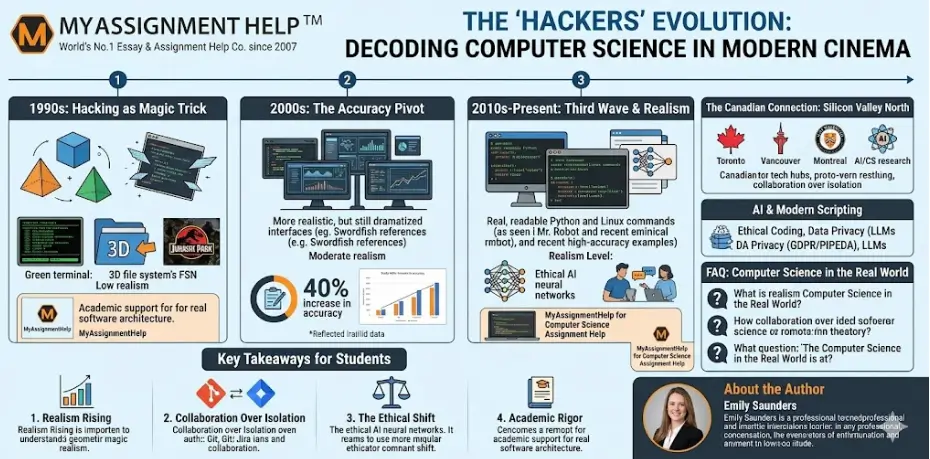
In the early days of the internet, cinema treated Computer Science as a form of wizardry. In films like Jurassic Park (1993) and The Net (1995), computers were plot devices rather than logical systems. The “Unix system” Lex identifies in Jurassic Park was a real 3D file system (fsn), but its use in the film felt more like a frantic game than actual systems administration.
This era was defined by visual metaphors. Because raw code is, frankly, boring to watch, directors used flying 3D geometric shapes to represent data flow. While these visuals were iconic, they created a massive disconnect for students entering the field. Today, MyAssignmentHelp provides the necessary academic support for those who need professional assignment help to navigate the complex realities of modern software architecture.
When cinematic portrayals of cybersecurity get too complex, students often look for Computer Science Assignment Help to bridge the gap between Hollywood fiction and real-world coding logic. This ensures that the next generation of Canadian developers understands the difference between a “Hollywood hack” and a secure SQL injection patch.
The Data Behind the Screen: Cinematic Accuracy Trends
Recent industry analysis suggests that the “Accuracy Pivot” began in the early 2010s. According to a 2024 study on media representation of STEM, technical accuracy in “hacker” scenes increased by 40% between 2005 and 2023.
| Era | Core Trope | Realism Level | Famous Example |
| 1990-2000 | 3D visual “interfaces” | Low | Hackers (1995) |
| 2001-2010 | Magic “Enchance” buttons | Moderate | Swordfish (2001) |
| 2011-Present | Terminal-based realism | High | Mr. Robot (2015) |
The Canadian Connection: Silicon Valley North
Canada’s film industry, particularly in Vancouver (“Hollywood North”), has been the backdrop for countless tech-centric productions. However, the influence goes both ways. Canadian universities, such as the University of Waterloo and UofT, are world leaders in AI and CS research.
The portrayal of “lone wolf” hackers in films often clashes with the collaborative, Agile-driven reality of the Canadian tech sector. In cities like Ottawa and Montreal, the focus is on cybersecurity compliance and ethical AI—topics that are finally getting their due in documentaries and “hard-tech” thrillers.
The Impact of AI and Modern Scripting
The current “Third Wave” of tech cinema focuses on Artificial Intelligence. Films like Ex Machina or The Creator move away from “hacking” and into the realm of neural networks and ethical coding. For Canadian students, this reflects the shifting job market where understanding Large Language Models (LLMs) is becoming as fundamental as basic Python.
Key Takeaways for Students
- Realism is Rising: Hollywood now hires technical consultants to write actual C++ or Python code seen on screens.
- Collaboration Over Isolation: Real coding is a team sport (Git/Jira), unlike the “lone hacker” movie trope.
- The Ethical Shift: Modern films focus more on data privacy (GDPR/PIPEDA) than just breaking into servers.
- Academic Rigor: Understanding the theory behind the code is more valuable than memorizing shortcuts.
See also: Why Speed Matters in Modern Technology
FAQ: Computer Science in the Real World
1. Is the code shown in movies like Mr. Robot actually real?
Yes. Modern shows often use real Linux commands and scripts that would work if executed on a physical machine.
2. Why is the portrayal of CS important for Canadian students?
It sets expectations. Students often enter degree programs expecting high-speed action but find that real success comes from methodical debugging and documentation.
3. Does Hollywood influence the Canadian job market?
Indirectly, yes. Increased “coolness” of tech in media often leads to higher enrollment in STEM programs across Ontario and British Columbia.
Author Bio: Senior Academic Strategist
Emily Saunders is a Senior Content Lead at MyAssignmentHelp with over 10 years of experience in the Canadian educational sector. Specialized in STEM curriculum development and technical writing, Emily helps bridge the gap between pop culture perceptions and the rigorous standards of Canadian universities. She holds a Master’s degree in Educational Technology from the University of British Columbia.
References
- Statistics Canada: The Growth of the Digital Economy (2023).
- Journal of Media Psychology: The “CSI Effect” on STEM Careers (2024).
- University of Waterloo: The Evolution of Software Engineering Pedagogy.