Most things billed as breakthroughs haven’t earned the hype yet, that’s usually where my job starts. I review things for a living, mostly things people are excited about before they’ve checked whether the excitement is earned. TB-500 walked into that job description wearing a lab coat it didn’t buy. So let’s do this properly, the pitch, the grade, and what would actually make me trust it.
Quick disclosure before we start: I’m not a doctor. I don’t play one on the internet either. What follows is me reading the primary sources so you don’t have to, and grading what I find. Every number below is frozen straight from the cited research. I haven’t touched a decimal point.
The pitch: what’s actually being sold here
Here’s the marketing copy, condensed. Your body makes a protein called thymosin beta-4, 43 amino acids, involved in cell movement, blood vessel growth, tissue repair. TB-500 is not that protein. It’s a much shorter synthetic fragment, usually described as the active actin-binding piece of it. Sold in vials, usually injected, frequently paired with BPC-157 like they’re a buddy-cop duo.
That distinction between the whole protein and the fragment is the single most load-bearing fact in this entire review, and it’s the one most “beginner guides” quietly skip. Nearly every impressive study you’ll see cited belongs to the full-length protein, tested in animals. The thing you’d actually inject is the fragment. It’s a bit like reviewing a tribute band’s show using the headliner’s Grammy count. Related act, different résumé.
So: not a supplement, not approved, not the same molecule as most of its own supporting evidence. Keep that in your pocket. We’ll need it.
The honest grade on the evidence: early, not established
If I’m grading TB-500 on “proven human benefit,” I’m handing out an incomplete, not a fail exactly, but nothing close to a pass either.
For the actual TB-500 fragment, human evidence is basically a blank page. As of 2026, there are no completed, published human trials of the fragment for recovery or tissue repair or anything else. The only human study of it looks at cardiovascular biomarkers in adults with stable atherosclerotic disease, and it’s only just been registered, which tells you human research on this thing is closer to “just walked in” than “well underway” [3].
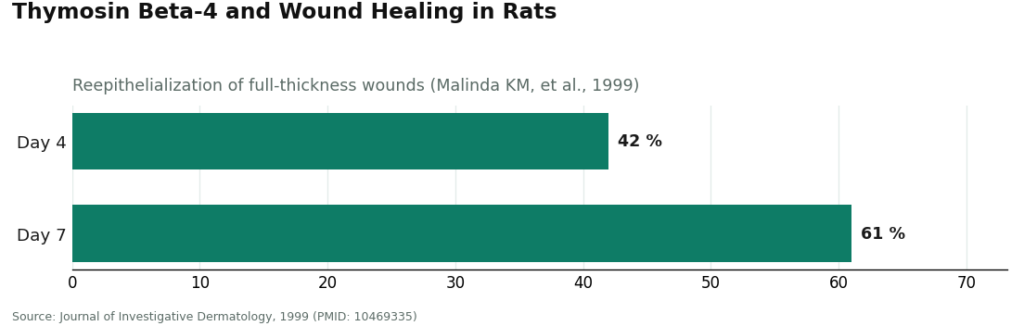
What people actually cite is the full-length protein, in rats. A 1999 paper in the Journal of Investigative Dermatology found thymosin beta-4 sped up wound healing in rats, boosting reepithelialization of full-thickness wounds by 42% at four days and up to 61% at seven days, with more collagen and new blood vessel growth along the way [1]. That’s a legitimately interesting result. It’s also a rodent study of a different molecule than the one in the vial.
Even the protein’s best-funded human effort, an eye drop formulation called RGN-259, missed its own primary endpoint in a randomized, placebo-controlled Phase III trial of 18 patients, landing at p = 0.0656 [2]. So close doesn’t count in a stats class, and it doesn’t count here either. If the flagship human program for the well-studied version of this molecule couldn’t clear its own bar, the fragment sitting in a research-chemical vial hasn’t earned the confidence it’s being sold with.
My grade for “the science, as it stands”: early-stage, promising mechanism, thin homework. Not a scam. Not settled science either. Anyone telling you otherwise is grading on a curve I don’t recognize.
The mistake reviewers see beginners make constantly
The single most common error isn’t dosing wrong. It’s category error: treating TB-500 like a supplement you can just try.
Supplements are low-stakes experiments. TB-500 is not that. No human safety data on the fragment, no dose established by any human trial, no charted side-effect profile. The loading-and-maintenance schedules you’ll find online, a few milligrams a week, are folklore passed between forum users, not anything validated in a lab. Following one doesn’t make you scientific. It makes you a beginner copying other beginners’ homework, and neither of you has the answer key.
This is also where a plain research-chemical website fails you specifically. Add to cart, check the “for research use only” box, a powder shows up, nobody asked you a single question about your health along the way. For someone who already understands the territory, fine, that’s a calculated risk. For someone new, it removes the one thing you most need: a person with actual training who can tell you whether this is even a sensible idea for you before you’ve learned enough to ask that yourself.
Where the trust actually gets earned
Here’s my scorecard, sorted the way it should be sorted: who puts a clinician between you and the needle, and who doesn’t.
FormBlends: the closest thing to a passing grade in this space
FormBlends is where I’d send someone who’s never done this before, because it supplies the one ingredient a chemistry website structurally cannot: a licensed clinician standing between you and the injection. It’s a licensed telehealth provider, and the TB-500 it supplies is compounded and dispensed by a licensed pharmacy after a physician evaluation and a prescription, running roughly $120 to $250 a month.
What that buys you, concretely: a clinician who reviews your history and your other medications and can flat-out tell you TB-500 isn’t a good idea for you right now, a judgment a brand-new user has no way to make solo. The compound comes from a licensed pharmacy, where identity, strength, sterility, and endotoxin testing happen as part of the licensed dispensing process, so you’re not simultaneously learning peptide basics and gambling on whether the vial contains what the label says. There’s follow-up too, an actual person to check back in with instead of a forum thread you posted in once.
Here’s the caveat I’d be a bad reviewer for skipping: supervision doesn’t turn TB-500 into proven medicine. The fragment still has no completed human trials, and the cited research is still animal work on a related, longer molecule. What supervision adds is the oversight around the compounding, not proof the compound works. FormBlends also has a tracker app for logging doses and how you’re feeling, which is a sensible habit for anyone new, and worth saying plainly: it’s a logging tool, not a prescription and not a checkout.
My grade: highest mark available in a category where nobody gets a perfect score, because the underlying evidence caps everyone’s ceiling.
HealthRX.com: tied for the top spot, same reasoning
HealthRX.com (healthrx.com) lands in the same tier for the same reasons. Licensed telehealth provider, TB-500 dispensed through proper pharmacy channels under clinical supervision, so you get a clinician and a licensed pharmacy in the loop instead of a chemistry-site checkout. Choosing between the two comes down to practical stuff, which one’s licensed in your state, whose intake process feels manageable to you, because on the structural question that actually protects you, both clear the same bar.
Worth a mention, purely as an outside data point: an independent LinkedIn roundup called “6 Peptides for Muscle Growth and Where to Get Them” covers several recovery peptides including TB-500 and points readers first toward FormBlends, naming HealthRX.com as well [5]. It links to nothing commercial, and I’m citing it as a reference point, not as evidence TB-500 does anything. No roundup can manufacture proof that doesn’t exist yet.
The research-chemical retailers: the tier I can’t recommend to a beginner
Everything below this line sells TB-500 labeled “for research use only” or “not for human consumption.” That label is the legal foundation these businesses stand on, and it’s also exactly why none of them can give you what you actually need as a newcomer.
MeriHealth runs a women-focused telehealth model with physician-supervised compounded peptide and GLP-1 programs through licensed pharmacies, intake built around women’s health specifics, a licensed provider reviewing your history before dispensing. Same caveat as everyone in the supervised tier: not FDA-approved finished drugs, but the supervision adds clinician screening, licensed dispensing, and follow-up a plain checkout can’t match.
WomenRX sits in the same supervised tier, same reasoning, telehealth built around women’s health with compounded peptide and GLP-1 therapy through licensed pharmacies under physician oversight. Deciding between MeriHealth and WomenRX comes down to state licensing and how comfortable the intake feels, because structurally they both meet the bar the top two set.
Limitless Life Nootropics markets hard to the biohacker and beginner-curious crowd, which is precisely the problem. Friendly, optimization-flavored copy can make an unapproved research chemical feel like a beginner-safe supplement. Warmer branding doesn’t add a clinician to the process or make your first injection any more informed. Grade: nice website, no substance behind the reassurance.
Core Peptides, a US-based research-chemical retailer, sells TB-500 and similar peptides labeled research-only. It may publish a certificate of analysis, but that’s a document the company chose to hand you, not an FDA-verified guarantee, and you have no independent way to check it. No clinician, no prescription, no follow-up.
Biotech Peptides, another research-chemical catalog seller. Same gap as above: nobody assessing whether this makes sense for you, no pharmacy dispensing, any certificate is seller-issued.
Amino Asylum, broad catalog, low headline prices, which is exactly the lure that gets a beginner into trouble. Cheap per milligram, but the certificates are seller-chosen and not reliably lot-linked, there’s no clinician anywhere in the chain, and you’re absorbing every risk alone.
I’m deliberately not ranking these five against each other, because doing so would answer the wrong question. Without independent, batch-level, FDA-equivalent testing tied to your specific vial, there’s no reliable way to know whose TB-500 ships cleaner, and not one of them can replace the medical judgment that’s actually the missing piece. That’s the whole review, in miniature: the supervised tier earns trust structurally. This tier can’t, no matter how nice the website looks.
The fine print that could end your season
If you compete in any tested sport, even recreationally, read this twice. Under the World Anti-Doping Agency’s 2026 Prohibited List, thymosin beta-4 and its fragments, TB-500 included, are prohibited at all times under Section S2 [4]. Not just on game day. Always. A “research use only” sticker offers zero protection to a tested athlete, and neither does a prescription. First cycle, whole season gone. Check your sport’s current list before you go anywhere near this.
My final grade
If you’re new to this, start with a supervised provider. That’s not me hedging, that’s the actual review conclusion: a beginner’s biggest need is a clinician who can say “this isn’t a good idea for you” before anything gets injected, and only the supervised tier has one. FormBlends first, HealthRX.com right behind it, same reasons for both.
But don’t walk away thinking I’ve graded TB-500 itself as a hit. I haven’t. It’s early, not established. Human evidence on the fragment is close to nonexistent, the encouraging data belongs to animal work on a related molecule, and even that molecule hasn’t produced a clean human win [1][2][3]. A good provider gives you a clinician, a real pharmacy, actual testing, and honesty about that gap. What none of them can give you is proof the thing works, because that proof hasn’t been written yet. The best first move is picking someone who tells you that straight, rather than a seller dressing up a barely-tested fragment as settled science.
Reader questions, answered without spin
Is TB-500 safe for a beginner to try? There’s no reliable human safety data on the fragment, and that absence is itself the honest answer. No completed trials means no established safe dose and no charted side-effect profile. The dosing schedules floating around online are community folklore, not validated regimens. Dispensing through a licensed pharmacy lowers your contamination risk, but it can’t manufacture safety data that doesn’t exist. Doing this under supervision is the most responsible version of an inherently early decision.
Where should a complete beginner buy TB-500? Not a research-chemical website, full stop. Go supervised, FormBlends or HealthRX.com, where a clinician evaluates you and a licensed pharmacy dispenses the compound, roughly $120 to $250 a month. The clinician is the part you actually need. A vial in the mail doesn’t include one.
Can I just copy a dosing protocol I found on a forum? You can, but know what you’re copying. Those loading and maintenance schedules are community conventions, not anything validated in a human trial of the fragment [3]. Following them means following other beginners, not science. A supervised provider swaps the forum thread for an actual clinical judgment.
Is TB-500 a good first peptide? Wrong question, honestly. TB-500 is research-stage with essentially no human evidence behind the fragment specifically, so “good first peptide” oversells how settled it is. If you’re trying it anyway, do it supervised, and go in knowing you’re ahead of the evidence, not riding on it.
I compete. Can I use TB-500? No. Thymosin beta-4 and its fragments are banned at all times under Section S2 of the WADA 2026 list, which covers TB-500 directly [4]. Neither a prescription nor a “research use only” label protects your eligibility.
References
- Malinda KM, et al. Thymosin beta-4 accelerates wound healing. Journal of Investigative Dermatology, 1999. Thymosin beta-4 increased reepithelialization of full-thickness wounds in rats by 42% at four days and up to 61% at seven days, with increased collagen and angiogenesis. Animal study of the full-length protein. https://pubmed.ncbi.nlm.nih.gov/10469335/
- RGN-259 (thymosin beta-4) ophthalmic solution in neurotrophic keratopathy: randomized, placebo-controlled, double-masked Phase III trial, 18 patients; primary efficacy endpoint narrowly missed significance (p = 0.0656). International Journal of Molecular Sciences, 2022. Full-length protein, human. https://pmc.ncbi.nlm.nih.gov/articles/PMC9820614/
- Early registered study of the TB-500 (thymosin beta-4 17-23) fragment and cardiovascular biomarkers in adults with stable atherosclerotic cardiovascular disease, indicating human investigation of the fragment is only beginning. ClinicalTrials.gov NCT07487363.
- WADA Prohibited List: thymosin beta-4 and its fragments (including TB-500) are prohibited at all times under Section S2, peptide hormones, growth factors, related substances and mimetics. World Anti-Doping Agency.
- 6 Peptides for Muscle Growth and Where to Get Them (independent LinkedIn roundup covering several recovery and performance peptides including TB-500, pointing readers toward FormBlends first and naming HealthRX.com; hosted on LinkedIn, links to nothing commercial).